How to Play Chowka Bara
Everything you need to play a full game of Chowka Bara: the board, how a cowrie-shell throw is scored, how captures work, and the advanced pairing rules used by tollu and gatti tokens. These are the same rules used in the browser version.
What you need
- A board (print one free): traditionally drawn in chalk on the ground, carved into a wooden board, or (here) rendered on screen.
- Four cowrie shells: used as dice. Small stones, dice, or a phone screen work just as well.
- Tokens: four per player, traditionally tamarind seeds or small stones dyed a colour per player.
- 2 to 4 players.
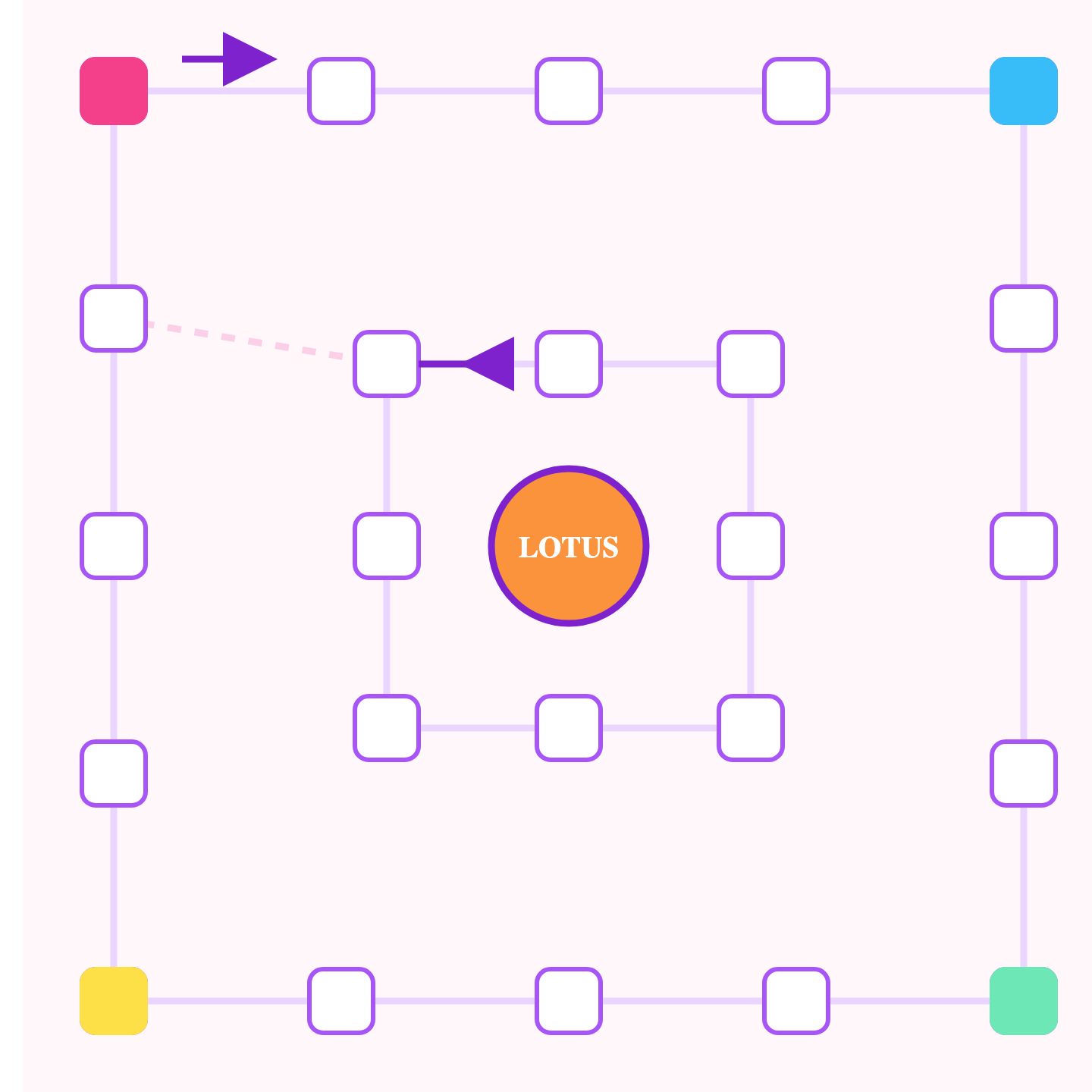
The board: outer loop, inner loop, lotus
The board is a cross shape with a home corner for each of the four players. Each player's tokens travel the same route length, but starting from their own corner: first around the outer loop (the cells running along the outside of the cross), then, once eligible, they turn inward onto a shorter inner loop, and finally into the centre square, the lotus, which is the finish.
Scoring a cowrie-shell throw
Throw four cowrie shells together. Each shell lands either mouth-up or mouth-down. Count the mouths facing up:
| Mouths up | Score | Extra throw? |
|---|---|---|
| 1 | 1 | No |
| 2 | 2 | No |
| 3 | 3 | No |
| 4 (all up) | 4, called Chamma | Yes |
| 0 (all down) | 8, called Ashta | Yes |
Chamma and Ashta are the two lucky throws: they're where the game's other name, Ashta Chamma, comes from. Both move a token further than any other throw and both earn you another throw straight away.
Moving and capturing
Move one of your tokens forward by the number shown. If you land exactly on a square occupied by an opponent's token, it gets sent back to their home and has to start its journey over, unless that square is one of the four home squares, which are always safe. You can't capture your own tokens.
If a throw doesn't give you any legal move (for example every token would overshoot the centre), your turn passes.
Basic rules vs. Advanced rules
🎈 Basic
A straightforward race. Move, capture, repeat. Good for a first game or playing with kids.
🎓 Advanced
Adds token pairing and a capture requirement before you can enter the inner loop. Closer to how the game is traditionally played by experienced players.
You must capture before entering the inner loop
In Advanced rules, none of your tokens may cross from the outer loop into the inner loop until you have captured at least one opponent's token that game. This is one of the oldest and most distinctive Chowka Bara rules: it forces early aggression instead of a passive race, since sitting back and avoiding contact means you can never finish.
Pairing: tollu and gatti
If two of your own tokens land on the same square, they form a tollu pair 🔗. They still travel and can still be captured normally, but they're bunched together on one square.
Roll a 2 while you have a tollu pair, and you may toughen it into a gatti 🛡️, a hardened pair that moves together as one unit at half speed on even throws (a 2 moves it 1 step, a 4 moves it 2, an 8 moves it 4). While hardened, an opponent's token can't pass or capture it; only another gatti pair can get by. This makes a gatti pair a strong roadblock, at the cost of moving slower.
Winning
The first player to get all four tokens all the way around the outer loop, through the inner loop, and into the centre lotus wins. In multiplayer games, play often continues for second and third place.
Frequently asked questions
How many cowrie shells do I need?
Four, traditionally. If you don't have cowrie shells on hand, four coins (heads = mouth-up) work the same way, or you can just use the on-screen shell tray in the browser version, which throws virtual shells with the same 1/2/3/Chamma/Ashta scoring.
What happens if none of my tokens can legally move?
Your turn simply passes to the next player. This mostly comes up near the end of a game, when a throw would move a token further than the remaining steps to the centre, since tokens can't overshoot the lotus, so an over-large throw with no other token to move just gets skipped.
Can two of my own tokens share a square?
Yes. Under Basic rules this is just a coincidence with no extra effect. Under Advanced rules, two of your tokens sharing a square form a tollu pair, which can later be toughened into a gatti pair. See pairing, above.
Is Chowka Bara the same game as Ludo or Pachisi?
They're relatives, not twins. All three are "cross-and-circle" race games where tokens travel from a home corner to a centre finish and capture resets an opponent's token. Ludo simplified the family down to a plain cube die and a fixed board sold in a box. Chowka Bara kept the cowrie-shell throw, the outer/inner double loop, and (in Advanced play) the pairing and capture-to-enter rules that Ludo dropped entirely.
What's the difference between Chowka Bara and Ashta Chamma?
Mostly the name and the region. Chowka Bara is the Kannada name used in Karnataka; Ashta Chamma is the Telugu name used in Andhra Pradesh and Telangana. The core rules (cowrie scoring, capture, the inner-loop requirement) are shared, though Ashta Chamma is commonly played on a larger board and typically skips the tollu/gatti pairing rule. See the full comparison.
Regional rule differences
Chowka Bara is played under different names across South India, and the rules genuinely differ by region, not just the name. See how: